
Top Agricultural Products Exported from India — A Complete Guide for Global Buyers in 2026
- Home
- >
- Blog
Top Agricultural Products Exported from India — A Complete Guide for Global Buyers in 2026
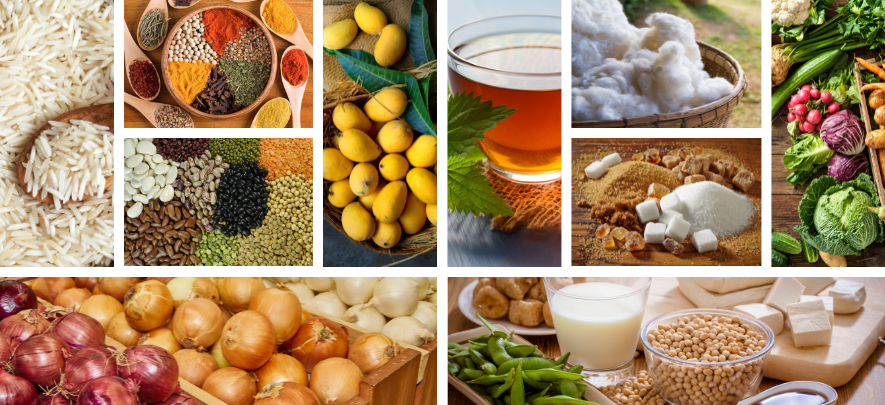
India feeds the world in more ways than most people realize. From the aromatic basmati paddies of Punjab to the cardamom estates of Kerala's Western Ghats, from the red chilli fields of Andhra Pradesh to the sesame belts of Gujarat — India's agricultural diversity is unmatched anywhere on the planet. And global buyers are increasingly aware of this.
In FY 2024–25, India's agricultural and allied exports reached USD 51.91 billion — a robust 6.47% growth over the previous year's USD 48.8 billion — even as the country's total merchandise exports grew by just 0.1% in the same period. Agriculture was, in other words, one of the few segments carrying India's export engine forward. If you are a global importer, food distributor, restaurant procurement manager, or supermarket buyer, understanding what India exports — and why it matters to your business — is not optional. It is a competitive necessity.
This guide covers India's top agricultural export commodities, the data behind the demand, and what buyers need to know to source smartly and compliantly.
India's Agricultural Export Landscape: The Big Picture
India's agricultural export portfolio spans an extraordinary range — from staple cereals and protein-rich pulses to premium spices, plantation crops, fresh produce, and processed foods. The country consistently ranks among the world's top five agricultural exporters, with APEDA (Agricultural and Processed Food Products Export Development Authority) contributing approximately 51% of India's total agri-export value.
In FY 2024–25, APEDA-registered exporters served buyers across more than 100 countries. The current trajectory suggests India's farm exports could breach USD 55 billion in FY 2025–26, potentially surpassing the previous record of USD 53.1 billion set in 2022–23. For global importers, this is not a market to observe from a distance — it is one to engage with actively and strategically.
1. Basmati Rice — India's Premium Export Crown Jewel
There is arguably no Indian agricultural product more globally recognized than basmati rice. Its extraordinary grain length, distinctive floral aroma, and non-sticky texture after cooking make it irreplaceable in cuisines across the Middle East, South Asia, Europe, and increasingly, mainstream Western retail.
India is the world's largest exporter of basmati rice, and the FY 2024–25 data reflects this dominance emphatically — basmati exports reached 6.06 million tonnes, valued at approximately USD 5.94 billion. Iran, Iraq, Saudi Arabia, the USA, and the UAE are consistently the top five destination markets.
For importers, basmati is one of the most structured and trackable Indian exports — APEDA's system of over 43,000 Registered Commercial Agri-Contracts (RCACs) ensures the trade is tightly documented, highly compliant, and built for consistent repeat business rather than speculative one-off transactions.
What buyers should know: Basmati grades vary significantly — from 1121 Extra Long Grain to Traditional Pusa Basmati and aged varieties. Always specify grade, grain length, moisture content, and packaging format when sourcing. APEDA-registered exporters are mandated to comply with Basmati Export (Quality Control) Regulations — an important compliance layer that protects buyers.
2. Non-Basmati Rice — The Volume Powerhouse
While basmati commands premium pricing, non-basmati rice is India's volume workhorse in the global grain trade. Rice exports from India surged to 21.55 million metric tonnes in 2025, up sharply from 18.05 million tonnes in 2024, as India lifted the export restrictions it had briefly imposed to stabilize domestic prices.
This rebound was transformative for global markets — Asian rice prices fell to their lowest levels in nearly a decade as Indian supply re-entered the market, providing significant relief to food-deficit economies across Africa, Southeast Asia, and parts of the Middle East.
Key non-basmati varieties in high export demand include parboiled rice, raw white rice, broken rice, Ponni rice, Sona Masoori, and Idli rice, with buyers across Africa, Sri Lanka, Malaysia, and the Gulf consistently among the largest volume importers.
What buyers should know: Non-basmati rice is governed by quality controls and phytosanitary requirements. Buyers should specify variety, grade, broken percentage, moisture level, and packing format. LCL consolidation is available for buyers not yet ordering full container loads.
3. Spices — India's Most Aromatic Export Category
India is the world's largest producer, consumer, and exporter of spices — a claim that has held true for centuries and shows no sign of changing. In FY 2024–25, India exported 17.99 lakh tonnes of spices and spice products, valued at USD 4.72 billion — a remarkable 17% increase in volume over the previous year.
Spices account for 9% of India's total agricultural export basket and more than 40% of its horticultural exports. The trajectory is equally compelling — India's domestic spice market, valued at ₹2,00,643 crore in 2024, is projected to reach ₹5,13,253 crore by 2033 at a CAGR of 10.56%, creating enormous upstream production expansion for exporters to draw from.
India's most commercially significant spice exports include:
- Turmeric — Erode (Tamil Nadu) produces the world's finest curcumin-rich turmeric, in surging global demand from food, pharmaceutical, and wellness industries.
- Red Chilli — Guntur (Andhra Pradesh) and Byadgi (Karnataka) varieties dominate global chilli export markets, prized for heat profile and colour value.
- Cumin (Jeera) — India supplies over 70% of global cumin, primarily from Gujarat and Rajasthan.
- Cardamom — Kerala's green cardamom commands a significant premium in Middle Eastern, European, and North American markets.
- Black Pepper — Tellicherry and Malabar pepper from Kerala are globally recognised as the benchmark for pepper quality.
- Coriander Seeds — Rajasthan's Eagle and Scooter varieties are in steady demand from food manufacturers and restaurants worldwide.
What buyers should know: Spice exports are regulated for pesticide residues (MRL compliance) in destination markets, particularly the EU, UK, and USA. Always request lab test reports alongside phytosanitary certificates.
4. Pulses — Global Demand for India's Protein Staples
India's pulse production diversity is extraordinary — Toor dal, urad dal (black gram), chana (Bengal gram), masoor (red lentils), moong, and kabuli chana (chickpeas) are all produced at significant scale. India is both a major producer and, for surplus varieties, a consistent exporter.
Pulses are experiencing a structural demand surge globally — driven by the mainstreaming of plant-based diets, the South Asian diaspora's consistent consumption across the UK, Canada, Australia, and the Gulf, and the food industry's growing use of pulse protein in processed and functional foods.
For importers specifically serving South Asian communities — UK supermarkets, ethnic food distributors, Asian restaurant supply chains — reliable pulse sourcing directly from India eliminates the distributor premium paid when buying through local wholesale intermediaries.
What buyers should know: Pulse exports require phytosanitary certification. For the UK and EU, buyers should ensure their supplier provides MRL test data for each crop year. Phytosanitary requirements in Australia and New Zealand for pulses are particularly stringent — confirm with your customs broker before placing your first order.
5. Tea — A Heritage Export with Modern Premium Appeal
India is the world's second-largest tea producer and one of its most prestigious exporters, with Assam and Darjeeling varieties commanding exceptional recognition in global premium markets. Russia, the United Kingdom, and Iran are among the largest destination markets for Indian tea exports.
Darjeeling tea carries a Geographical Indication (GI) tag — one of the most rigorous origin certifications in global food trade — making it a protected and traceable product. For importers in premium retail, hotel supply, or specialty beverage channels, Indian tea remains an unrivalled sourcing opportunity.
What buyers should know: Bulk CTC teas for standard blends and premium whole-leaf teas for specialty retail are sourced differently. Specify your requirement — standard, orthodox, green, or specialty — clearly at the enquiry stage.
6. Coffee — South India's Specialty Export
South India's hill districts — particularly Coorg, Chikmagalur, and the Nilgiris, spanning Karnataka, Kerala, and Tamil Nadu — produce coffees of remarkable character. Indian coffee exports are predominantly washed and natural Arabica and Robusta varieties, with Europe and Japan as the primary destination markets.
The specialty coffee movement has brought Indian single-origin coffees into focus for premium roasters and importers globally, with growing interest in estate-specific and micro-lot offerings from these southern highlands. India's coffee exports are governed by the Coffee Board of India, which maintains quality standards and geographic certifications.
7. Fresh Fruits and Vegetables — India's Year-Round Tropical Advantage
India's diverse agro-climatic zones enable year-round production of tropical and subtropical fruits and vegetables. Alphonso mangoes from Maharashtra, Kesar mangoes from Gujarat, fresh okra, bitter gourd, fresh green chillies, and a range of specialty vegetables form the core of India's fresh produce export basket.
APEDA data shows that fresh fruits exports registered 29% growth in the April–December 2023 period, with India now exporting fresh produce to 111 countries compared to 102 destination markets the prior year — evidence of active market expansion. The Middle East and Southeast Asian markets are the dominant buyers of Indian fresh produce, driven by their large South Asian communities and year-round demand for authentic ingredients.
What buyers should know: Air freight is non-negotiable for fresh produce. Cold chain compliance from packhouse to aircraft loading is critical. Phytosanitary documentation and fumigation certifications are mandatory.
8. Oilseeds — From Groundnuts to Sesame and Castor
India is one of the world's largest producers of groundnut (peanut), sesame seed, castor seed, and linseed. These oilseeds serve multiple industries — edible oil processing, animal feed manufacturing, pharmaceutical and cosmetic production, and industrial applications.
Sesame seeds from India — particularly hull-free natural and white sesame — are in consistent global demand from food manufacturers, confectionery producers, and bakery businesses. Groundnut (peanut) exports, particularly blanched and oil-dried formats, serve snack food manufacturers and edible oil processors across Asia, Europe, and Africa.
9. Cotton — Supporting Global Textile Supply Chains
India is the world's largest cotton producer and one of its most significant exporters, with raw cotton and cotton yarn fuelling textile supply chains across Bangladesh, Vietnam, and China. While cotton falls outside the strict food commodity category, it is a critical part of India's broader agri-export ecosystem and reflects the scale and diversity of India's agricultural production infrastructure.
10. Floriculture — An Emerging, High-Value Category
India's floriculture export sector — encompassing fresh cut flowers, dried flowers, bulbs, seeds, and ornamental plants — is classified as an emerging high-value agri-export category by APEDA. The Netherlands, Japan, and the United Kingdom are currently the largest importers of Indian floriculture products, driven by growing demand for fresh blooms and decorative botanical products in retail and wellness channels.
For global buyers, the window to establish long-term, direct supply relationships with serious, certified Indian exporters is now. Supply chains built today, with compliant partners who understand your market's requirements, will deliver the competitive advantage your business needs.
The Compliance Architecture Buyers Cannot Ignore
India's agricultural export ecosystem is underpinned by two critical compliance bodies that every global buyer should understand:
- APEDA (Agricultural and Processed Food Products Export Development Authority) regulates, promotes, and certifies India's agri-exports. APEDA-registered exporters submit to product standards, minimum export prices (where applicable), and quality control protocols that protect buyers. In FY 2022–23, APEDA contributed 51% of India's total agri-export value — confirming that the most significant export volumes flow through this regulated channel.
- FSSAI (Food Safety and Standards Authority of India) licenses every food manufacturing and processing facility operating in India. For buyers, an FSSAI-licensed supplier is a supplier whose processing facility has been assessed against India's national food safety standards — a critical layer of due diligence for importers in regulated markets like the UK, EU, USA, and Australia.
Together, IEC + FSSAI + APEDA form the non-negotiable compliance baseline for any serious Indian food exporter.
Why Source Through an Experienced Indian Export Partner?
The data makes India's agri-export case compelling. But data alone does not ship a container. What converts India's agricultural abundance into reliable, compliant, on-time delivery for a global buyer is the quality of the export partner sitting between Indian farms and your warehouse.
A professional Indian agro export partner — FSSAI licensed, APEDA registered, and IEC compliant — handles:
- Sourcing precision — selecting the right variety, grade, and processing unit for your specification.
- Documentation completeness — commercial invoice, packing list, bill of lading, certificate of origin, phytosanitary certificate, fumigation certificate, and any destination-specific compliance documents.
- Quality assurance — pre-shipment inspection, lab testing, and loading supervision.
- Logistics coordination — sea freight (FCL/LCL), air freight for time-sensitive consignments.
- Compliance advisory — UK FSA, EU MRL, USFDA, and Gulf Standards Organisation requirements.
Final Word: India's Agricultural Export Story Is Still Being Written
India achieved USD 51.91 billion in agricultural exports in FY 2024–25 — and industry projections suggest USD 55 billion is achievable in FY 2025–26. The government has set an ambitious long-term target of USD 100 billion in agri-exports, with investments in cold chain infrastructure, port logistics, and food safety frameworks actively supporting that trajectory.
For global buyers, the window to establish long-term, direct supply relationships with serious, certified Indian exporters is now. Supply chains built today, with compliant partners who understand your market's requirements, will deliver the competitive advantage your business needs as Indian agri-exports continue their ascent.
Vasco Exim Overseas LLP is a Chennai-based, FSSAI licensed and APEDA registered Indian agro products exporter supplying premium rice, pulses, spices, flour, and processed foods to buyers across the United Kingdom, Sri Lanka, the UAE, Southeast Asia, and beyond.
Disclaimer: The information in this article is for general guidance only and does not constitute legal, financial or trading advice. If you are a buyer looking for a reliable exporter to source, procure and supply products across the globe, please contact us — Vasco Exim Overseas LLP is equipped to support your requirements end-to-end.